Scenario based selection of power exchange cabinets: balancing safety, efficiency, and practicality on the ground
With the widespread adoption of the two wheeled electric vehicle battery swapping mode, the battery swapping cabinet is no longer a single charging device, but a refined operation and maintenance terminal adapted to different scenarios. Choosing a battery replacement cabinet should not only focus on hardware parameters, but also be tailored to actual usage needs, flow patterns, and environmental conditions. It should match scenario specific functions from three dimensions: safety protection, intelligent adaptation, and operational efficiency, in order to avoid problems such as lagging operation and maintenance, poor compatibility, and excessive costs in the later stage. Based on the practical requirements of mainstream commercial scenarios, the following is a targeted selection guide.
Delivery rider distribution center: High frequency fast charging+durable resistance is the core
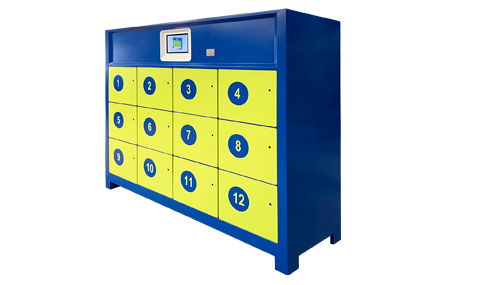
Delivery and errand riders are the most densely populated groups with the demand for battery swapping. Their stations are mostly located around commercial districts, at street intersections, and at the bottom of residential areas. They have three characteristics: high-frequency battery swapping, long-term full load operation, and outdoor placement. They have extremely high requirements for equipment stability and fast charging efficiency. For this type of scenario, priority should be given to 8-12 warehouse specifications, with a single warehouse output power of not less than 800W, achieving a fast full charge in 1.5 hours, meeting the needs of riders to change and leave at any time, and complete pick-up and return in 5 seconds, avoiding queue congestion.
At the hardware level, it must be adapted to complex outdoor environments. The cabinet is made of thickened galvanized steel plate with a protection level of IP54 or above, which can resist sun, rain, dust, and collision. It can adapt to temperature differences of -20 ℃ to 50 ℃ and eliminate the risk of electric leakage and high temperature fire in rainy days. The safety configuration should achieve independent control of a single warehouse, equipped with temperature control sensing, smoke alarm, and automatic fire extinguishing devices, combined with overvoltage, overcurrent, and reverse protection, to address safety hazards caused by battery mixing and aging. Simultaneously supporting power-off endurance, GPS positioning, and electronic anti-theft locks to prevent device theft and malicious damage, suitable for outdoor operation and maintenance environments facing the street.
Community residents share: Convenience and ease of use+low power consumption and quietness are more critical
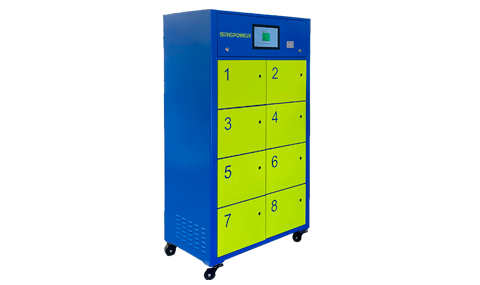
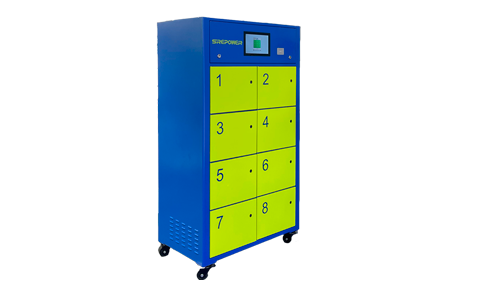
Community battery swapping mainly serves household electric vehicle users, with scenarios concentrated in community garages, property management, and convenient service points. Its characteristics include low frequency of battery swapping, dispersed users, sensitivity to noise and land occupation, and emphasis on convenience and safety. This type of scenario is suitable for compact cabinets with 6-8 compartments, with a small overall size that does not occupy public space. It is suitable for indoor semi enclosed or rain shelter environments, and has a protection level of IP54 to meet dust and moisture prevention requirements.
On the functional side, it emphasizes minimalist operation and is equipped with a high-definition touch screen. It supports scanning codes, one click battery swapping through mini programs, simplifies the payment process, and takes into account the user experience of elderly users. At the operational level, it is necessary to support custom billing models that can be flexibly switched between per use, on time, and monthly card usage. This should be accompanied by real-time monitoring of warehouse status and battery levels in the cloud backend, remote troubleshooting, and system updates to reduce offline operation and maintenance frequency. At the same time, it adopts a low-power design to reduce no-load energy consumption, operates quietly without interference, and avoids affecting residents' daily lives. The cabinet has a simple and versatile appearance that fits the community's environmental tone.
Logistics park/factory area: batch adaptation+remote operation and maintenance to improve efficiency
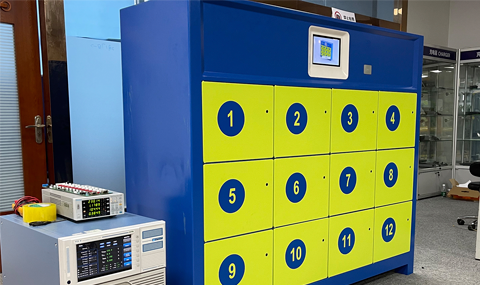
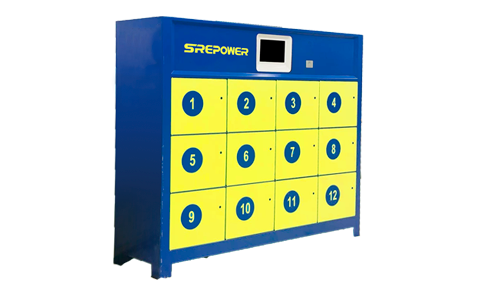
The demand for battery replacement in factory areas and logistics parks is mainly targeted at distribution vehicles, sanitation vehicles, and official electric vehicles, characterized by uniform battery specifications, batch battery replacement, centralized management, and high requirements for equipment compatibility and systematic operation and maintenance. For this type of scenario, priority should be given to large capacity cabinets with 10-12 compartments or more, compatible with mainstream batteries such as 48V, 60V, and 72V, and compatible with multiple battery cells such as ternary lithium and lithium iron phosphate. There is no need to bind a single battery model to reduce replacement costs.
The core requirement focuses on intelligent management, equipped with cloud operation and maintenance platform, real-time monitoring of battery SOC and SOH status, realizing battery health assessment, abnormal warning, intelligent balancing, and extending battery cycle life. Supporting API interface docking, it can be linked with the park management system and enterprise operation and maintenance platform to achieve data interoperability, batch reconciliation, and permission control. Hardware reinforced cabinet structure, wear-resistant and impact resistant, suitable for the dense traffic and complex personnel environment in the park. Combined with remote OTA upgrades and fault diagnosis, more than 90% of small problems do not require on-site maintenance, greatly improving operation and maintenance efficiency.
Ultimately, the core of choosing a battery swapping cabinet is to prioritize scene adaptation and ensure safety qualifications. Regardless of the application scenario, it is necessary to have qualifications such as security testing and certification, product liability insurance, etc., combined with traffic, environment, and operation and maintenance needs to match storage space, power, and intelligent functions, in order to select cost-effective, easy to implement, and easy to maintain equipment, so that the battery swapping mode can truly play the value of efficiency, safety, and convenience.
Hot Keywords:




 WhatsApp Contact
 WhatsApp Contact
